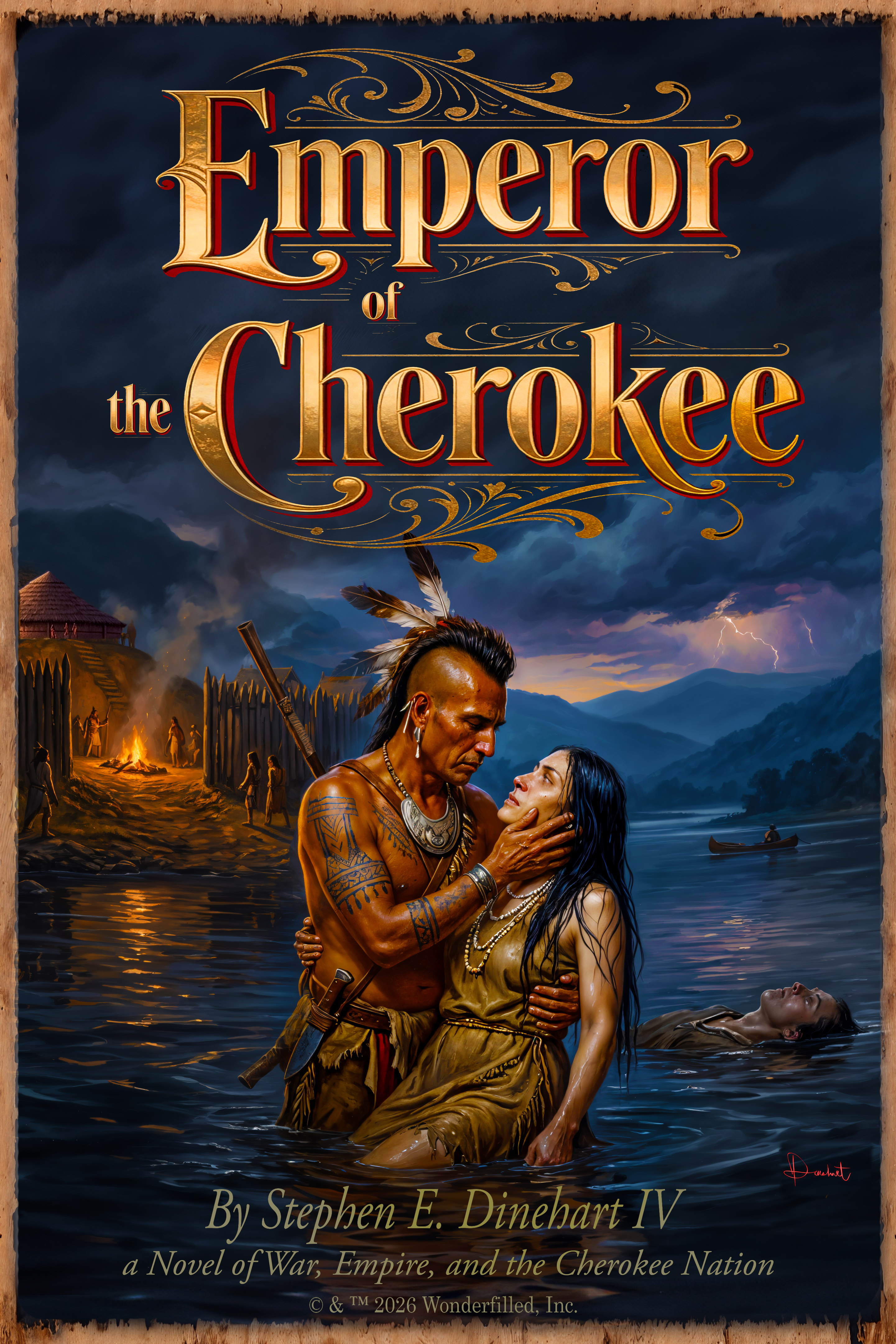
A Novel of War, Empire, and the Cherokee Nation
300 years ago they buried him. April 2026. He returns.
In 1687, a boy is born in a peace town on the Little Tennessee River. He will grow up to read rivers the way other men read trails, earn a warrior's title on a raid that turned on a narrow channel no one else saw, and marry a medicine woman whose power frightens even those who love her.
By 1730, a Scottish adventurer will cross the mountains with a scheme and a journal full of numbers, and place a metal rim on his head at Nequassee. He will send seven of his people across an ocean to meet a king. His wife will beg him not to.
Emperor of the Cherokee is the story of Moytoy of Tellico — war chief, river runner, husband, father — and the woman who saw what was coming before anyone else believed her. Set in the mountains and rivers of the Cherokee Overhill country, it is a novel of love, power, prophecy, and the cost of being caught between two worlds that cannot coexist.

~1687–1741
War chief of Talikwa. River runner. Husband.
Born at Itsa'sa, the peace town on the Little Tennessee. He used blowguns, never bows — his father's weapon, seven and a half feet of river cane with a mouthpiece worn smooth by two men's breath. He earned his title reading water, finding the narrow channel others would have missed. He married a medicine woman from Si'tiku who could see what was coming. The British called him Emperor. He never used the word for himself.
Unknown–1730
Medicine woman of Si'tiku
She came from the medicine town, from a lineage that kept the Uktena crystal — small, no larger than a walnut, clear at the center and clouded at the edges. Her hands were still, her fingers slightly curved, as though holding something invisible. She read the world. He acted in it. She set broken bones with one precise motion and saw futures that arrived whether or not anyone listened.
~1705–~1780
Diplomat. Speaker between empires.
Mid-twenties when Moytoy chose him at Nequassee. Crossed the Atlantic, walked through London, learned the system from the inside. Captured by Ottawas, he spent five years among the French before returning speaking three empires' languages. He watched mouths more than eyes. Filed everything. The British called him Little Carpenter because he shaped agreements like wood. He used their tools without loving them.
1738–~1822
Ghigau
Wolf Clan. Attakullakulla's niece. Her husband Tsu-la fell at the Battle of Taliwa when she was seventeen. She took his rifle. They named her Ghigau — Beloved Woman. Permanent seat on the Council of Chiefs. Leadership of the Women's Council. The right to speak at any council, any time, and the authority over who lived and who died among prisoners of war. She spoke at treaty councils for four decades. She held the title for sixty-seven years.
~1721–Unknown
Son of Moytoy and Aganunitsi
His father's build already visible in his shoulders. His mother's cheekbones, her way of holding silence — though in him, it was calculation, not vision. He carried the blowgun but not the gorget. The absence was visible.
~1738–1792
War chief. Attakullakulla's son.
His father shaped agreements. He broke them. At the 1776 council at Itsa'sa he said what others would not: We have no more land to give. Every treaty loses territory. Every negotiation is surrender by another name. He took five hundred warriors south to the Chickamauga towns. He died dancing.
1691–1775
Baronet. Fellow of the Royal Society.
Arrived in Charles Town with fifteen thousand pounds in fraudulent promissory notes and a scheme. Could not navigate the forest. Wrote constantly in his journal — numbers were what you showed a king when you wanted him to notice you. He carved KING GEORGE II in a cave wall with a belt knife. The letters were uneven.
Unknown
Scottish trader at Talikwa
Fifteen years in Cherokee country. Married a Cherokee woman. Had children with her. He had learned Cherokee patience even if he had not learned Cherokee thinking. When Cuming needed a translator, Grant compressed English into Cherokee that carried the shape of the words without carrying their weight. He stood between two worlds, belonging to whichever side did not need him to belong.
The novel follows the rivers and towns of the Cherokee Overhill country — the Little Tennessee, the Hiwassee, the mountains of what is now eastern Tennessee and western North Carolina.
Peace town. Mother Town.
Where Moytoy was born. Where the sacred fire was kept. The council house stood on the mound above the river. Sixty families lived here, organized by clan, governed by consensus.
War town. Red town.
Where Moytoy governed. The largest of the Overhill towns. War councils met here, trade delegations arrived here, and the rum kegs were counted here. The mound where the council house stood overlooked the river below.
Medicine town. White town.
Where Aganunitsi was born. The medicine lineage ran through the women of this town. Si'tiku's delegation moved with a discipline the other towns noticed.
Mound town. Middle Settlements.
Where the metal rim was placed on Moytoy's head. Three hundred people gathered on the mound in April 1730. The mound survives today in Franklin, North Carolina. In February 2026, the Town of Franklin transferred the deed to the Eastern Band of Cherokee Indians. The Noquisi Initiative stewards the site.
Overhill town.
The town that gave Tennessee its name.
~1687
Birth at Itsa'sa. Awi Usdi — "Little Deer" — born during the Green Corn Ceremony. The sacred fire newly rekindled.
~1693
Amatoya killed on the trade path. The boy is six.
~1700
The vigil. A night alone on a stone in the forest. He earns the warrior name Ayvda-woduhi — Storm-Walker.
~1712
Council names him Moytoy — The One Who Goes Between.
~1715
The guns arrive. Yamasee War. The council chooses separate peace with the British. Twenty wagons deliver four hundred muskets. Powder comes from British mills.
~1717
Moytoy marries Aganunitsi of Si'tiku. War town and medicine town joined.
1730
April 3, Nequassee mound. Cuming places a metal rim on Moytoy's head. Seven Cherokee sent to London.
1730
September 7, London. Articles of Friendship and Commerce signed. Cuming absent.
1755
Battle of Taliwa. Nanye'hi takes her fallen husband's rifle. Named Ghigau at seventeen.
1760
Fort Loudoun falls. British burn thirty towns.
1776
Itsa'sa burns. They rebuild.
1780
Itsa'sa burns again. They rebuild with fewer hands.
1830
Indian Removal Act.
1838
Removal. Sixteen thousand Cherokee.
2026
Nikwasi mound deed transferred to the Eastern Band of Cherokee Indians. The land returns.
Sign up for updates on Emperor of the Cherokee — release dates, readings, events, and the stories behind the story.
No spam. Unsubscribe anytime.