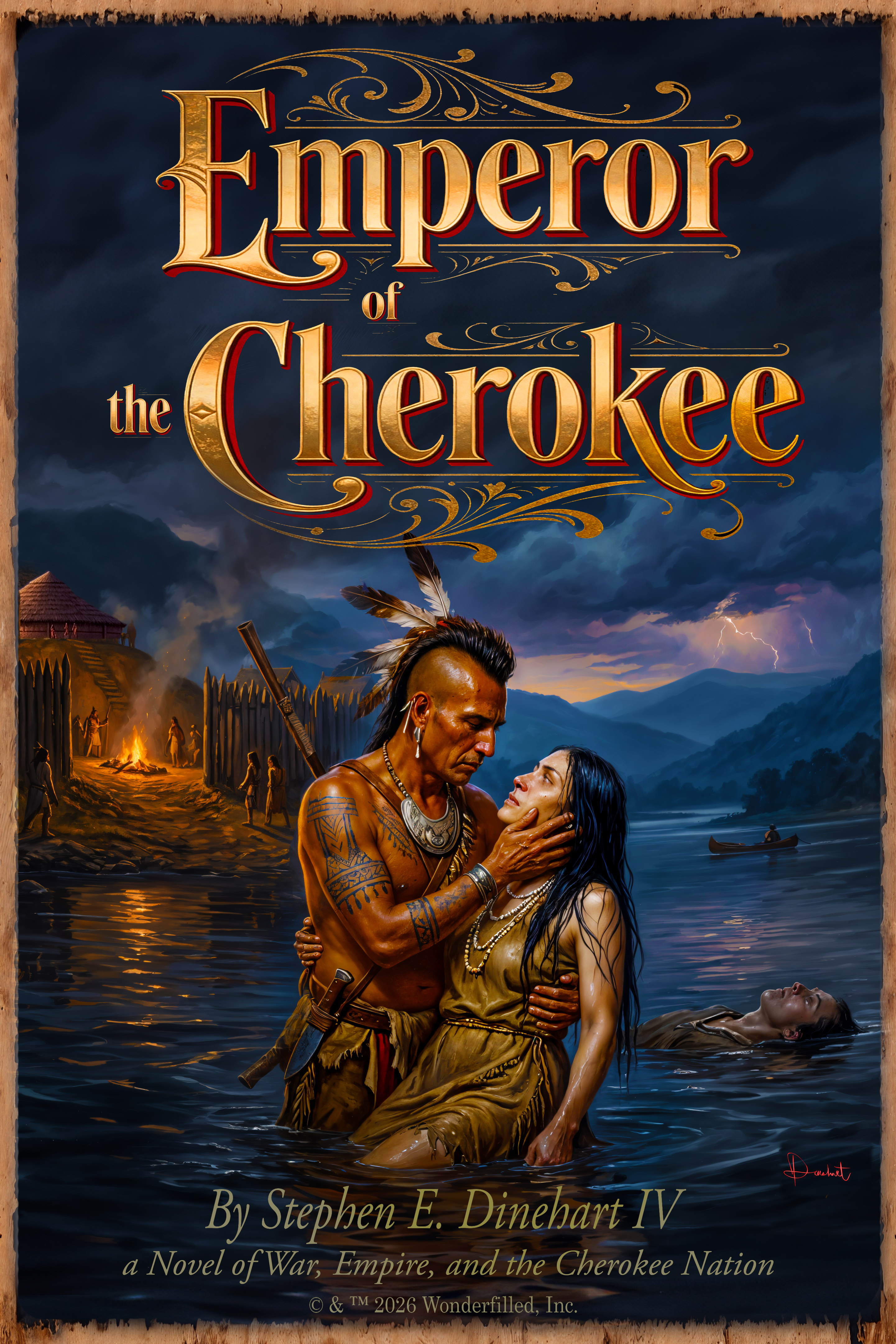
Emperor of the Cherokee

A Novel of Love, Empire, and Erasure

By Stephen E. Dinehart IV

Published April 3, 2026.

The 296th anniversary of the ceremony.

The mound is still standing.

— ✧ —

THE BOOK

Emperor of the Cherokee — Book Cover

"They drowned us in kindness." — Attakullakulla

In 1730, a British baronet arrives in the Cherokee towns with a single ambition: crown one man "Emperor" and bind the Cherokee Nation to the British Crown. The man chosen is Moytoy of Great Tellico — war leader, river guide, a man whose trust made him legible to two worlds.

He never uses the title for himself.

His wife Aganunitsi sees what it will cost. Her Uktena crystal shows her the future in fragments — water rising over the towns, drowning everything. She tells him: everything that you won't be able to stop. He takes the title anyway. Because someone has to stand between.

The guns require powder. The powder requires debt. The debt outlasts the men who owed it. The treaties promise protection and deliver the routes the smallpox follows. The towns burn. And the water Aganunitsi saw comes in 1979, when the Tennessee Valley Authority closes its file on the inundation project and the Little Tennessee goes still.

Emperor of the Cherokee spans nearly three centuries — from the living world of the Overhill towns to the TVA's administrative record, from the London throne room to the mound where the story is still being told. It follows Moytoy's life, his death, and the long unraveling: through the women who carried authority long after the Emperor title expired, through diplomats who negotiated and warriors who refused and fire-keepers who walked through burning towns with the coals pressed against their chests.

This is a novel about what was there before the water came.

Some histories end with battles.
This one continues.

Get the Book
— ✧ —

THE PEOPLE

Moytoy — The One Who Goes Between

~1687–1741

War chief of Talikwa. Called "Emperor" by the British.

Born at Itsa'sa, the peace town on the river. Earned his title reading water — the narrow channel others would have missed. The British placed a metal rim on his head at Nequassee in 1730 and called him Emperor. He never used the word for himself. The title had no Cherokee equivalent. It was a fiction useful to London, meaningless to the council houses.

Full biography →

Aganunitsi — Quatsy

Unknown–August 1730

Medicine woman of Si'tiku. Keeper of the Uktena crystal.

She read the world. He acted in it. Almost entirely a creation of the novel, built from the negative space of the archive — the woman who must have existed, whose presence shaped decisions the record attributes only to Moytoy. In Cherokee matrilineal society, a war chief's wife held structural importance that colonial documents were never designed to capture.

Full biography →

Attakullakulla — The Little Carpenter

~1705–~1780

Diplomat. Speaker between empires.

Moytoy chose him at Nequassee: Go. See their king. Learn what they are. Come back and tell us. He went to London at twenty-five and learned the system. Captured by Ottawas, he spent five years among the French before returning speaking three empires' languages. The British called him Little Carpenter because he shaped agreements like wood. His method sustained Cherokee sovereignty for forty-seven years. It exhausted when the Americans proved unwilling to hold agreements.

Full biography →

Nanye'hi — The Beloved Woman

1738–~1822

Ghigau. Sixty-seven years.

Named Ghigau at seventeen — the highest title a Cherokee woman could hold. Not honorary. The Ghigau held the right to speak in council, to commute death sentences, to determine the fate of captives. She held it for sixty-seven years — longer than any "Emperor," longer than any diplomat's method, longer than any warrior's resistance. She spoke at every treaty council for four decades. In 1817, she wrote from her sickbed: don't part with any more of our lands. Her monument calls her "Princess and Prophetess" and "Pocahontas of Tennessee." None of those words is Ghigau. None is Nanye'hi.

Full biography →

Amouskositte — Dreadful Water

~1721–Unknown

Son of Moytoy. Claimed the Emperor title after his father's death.

He claimed the Emperor title after Moytoy. Occupied the mound at Talikwa. Held the blowgun. Slept where his father had governed. When the British asked who speaks for the Cherokee, he said: I do. Old Hop at Itsa'sa told him what he already knew: Your father's title was for British ears. It has no meaning here.

Full biography →

Dragging Canoe — Tsi'yu-gunsini

~1738–1792

War chief. Attakullakulla's son.

His father negotiated. He fought. At the 1776 council he said what everyone knew: We have no more land to give. Every treaty loses territory. Every negotiation is surrender by another name. He took five hundred warriors south to the Chickamauga towns and fought for eighteen years. His resistance lasted eighteen years. His father's method lasted forty-seven. Both ended the same way.

Full biography →

Sir Alexander Cuming

1691–1775

The man who crowned an Emperor.

Arrived in Charles Town with fraudulent promissory notes and a scheme. Could not navigate the forest. Wrote constantly in his journal — numbers made things real. At Nequassee he placed a metal rim on Moytoy's head and declared him Emperor of the Cherokee. Took seven Cherokee to London as proof of his achievement. The colonial officials recognized the diplomatic value of what he had initiated and no longer needed him. He spent the remaining forty-five years of his life petitioning for recognition that never came.

Full biography →

Ludovic Grant

Unknown

Scottish trader. Interpreter. Complicit witness.

Fifteen years in Cherokee country. Married a Cherokee woman. Translated for Cuming — compressed English into Cherokee that carried the shape without carrying the weight. Joined the London journey unexpectedly. The trade system he participated in was the vector for the epidemics that devastated Cherokee towns. Grant was not the cause. He was the mechanism — present, useful, and willing to do what the situation required without examining what the situation was.

Full biography →
— ✧ —

THE LAND

The novel follows the rivers and towns of the Cherokee Overhill country — the Little Tennessee, the Hiwassee, the mountains of what is now eastern Tennessee and western North Carolina. Some of these places survive. Most do not.

Itsa'sa (Chota)

Peace town. Mother Town.

Where Moytoy was born. Where the sacred fire was kept. Burned by Americans in 1776 and 1780. Rebuilt both times by fewer hands. The town that survived fire did not survive the twentieth century. Memorial pillars on a constructed causeway mark where the council house stood.

Talikwa (Great Tellico)

War town. Red town.

Where Moytoy governed. Where Cuming arrived, and the trade ledgers accumulated, and the rum kegs were counted. No surface expression remains.

Si'tiku (Citico)

Medicine town. White town.

Where Aganunitsi was born in the novel. Where the crystal came from — taken from the great serpent's head by her grandmother's grandmother. No surface expression remains.

Nikwasi (Nequassee)

Mound town. Middle Settlements.

Where the metal rim was placed on Moytoy's head. The mound survives in Franklin, North Carolina. In February 2026, the Town of Franklin transferred the deed to the Eastern Band of Cherokee Indians — the first time in nearly two centuries that the land returned to Cherokee hands. The Noquisi Initiative stewards the site. The mound endures.

Tanasi

Overhill town. Origin of the name "Tennessee."

The town is gone. The state kept the name.

— ✧ —

THE TIMELINE

~1687

Birth at Itsa'sa. Awi Usdi — "Little Deer" — born during the Green Corn Ceremony. The sacred fire newly rekindled.

~1693

The fire goes out. Loss on the trade path. The boy is six.

~1700

The vigil. A night alone on a stone in the forest. He earns the warrior name Ayvda-woduhi — Storm-Walker. His uncle sat behind him all night, unseen.

~1712

The One Who Goes Between. A river raid, a narrow channel others would have missed. Council names him Moytoy. His mother: "Your father earned that title. Now you have earned it."

~1715

The guns arrive. Yamasee War. The council chooses separate peace with the British. Twenty wagons deliver four hundred muskets. Powder comes from British mills.

~1717

Breathing together. Moytoy marries Aganunitsi of Si'tiku. She brings the Uktena crystal, the medicine lineage, the shell gorget.

~1725

First vision. The crystal shows what is coming — women marrying traders, children speaking English first, pottery unused because of kettles. Absorption through accumulation, not invasion.

1730

The Emperor. April 3, Nequassee mound. Cuming places a metal rim on Moytoy's head. Seven Cherokee sent to London. Aganunitsi: "Two of three."

1730

August. The crystal opens for the last time. What Aganunitsi sees changes everything that follows.

1730

Articles of Friendship. September 7, London. Treaty signed in a smaller room by dark-clothed men.

~1738

Smallpox. It follows the trade routes, the rivers. Half the town dies.

1741

The Emperor's water. Summer. The title passes from the man who understood it to the son who wanted it to be real.

1755

Battle of Taliwa. Nanye'hi named Ghigau at seventeen. The highest title a Cherokee woman could hold.

1760

Fort Loudoun falls. British burn thirty towns. Attakullakulla negotiates the peace. It costs the hunting grounds east of the Blue Ridge.

1776

Itsa'sa burns. They rebuild.

1780

Itsa'sa burns again. One thousand houses destroyed. Fifty thousand bushels of corn. They rebuild with fewer hands.

1785

Treaty of Hopewell. Boundaries "forever."

1791

Treaty of Holston. One thousand dollars annuity. "Friendship, civilization."

1798

Treaty of Tellico. Signed at a blockhouse built where Talikwa's council house stood.

1808

Women's Council issues formal statement against land cession. The land is ceded.

1817

Nanye'hi writes from her sickbed: don't part with any more of our lands. The council cedes the lands.

1822

Nanye'hi dies at Womankiller Ford. Sixty-seven years as Ghigau.

1830

Indian Removal Act.

1835

Treaty of New Echota. Twenty unauthorized Cherokee sign. Ratified by one Senate vote. Thirteen thousand signatures in Sequoyah's syllabary petition against it.

1838

Removal. Sixteen thousand Cherokee. Supply calculation: one pound of flour per person per day. Four thousand dead.

1923

Monument erected. "Princess and Prophetess... Pocahontas of Tennessee... constant friend of the American Pioneer."

1979

The Overhill towns disappear. Talikwa, Itsa'sa, Si'tiku, Tanasi. No surface expression remains.

2026

Nikwasi mound deed transferred from the Town of Franklin to the Eastern Band of Cherokee Indians. The land returns.

April 3, 2026

Emperor of the Cherokee published. The 296th anniversary of the ceremony at Noquisi Mound. Written by a documented descendant. Built from two decades of research. The story gets told from here now.

— ✧ —

THE SOUND OF 1730

On March 11, 1730, Sir Alexander Cuming rode out of Charleston into Cherokee Overhill territory with no official authority, forged letters, and a plan. Twenty-three days later, at the Noquisiyi Mound, he declared Moytoy of Tellico "Emperor of the Cherokee." The declaration meant nothing to the Ani-Yun'wiya. It meant everything to the British.

Stephen E. Dinehart IV spent years inside that journey. His novel — Emperor of the Cherokee — published April 3, 2026, the 296th anniversary of the Nequassee ceremony. Before the book entered the record, he gave it sound.

The suite starts at Creation and moves through the Middle World, dawn at Itsa'sa, the Long Man of the river, the war town at Talikwa, Aganunitsi's Ulunsuti vision. It crosses into the colonial record with the Crown of Tannasy, hits the TVA flood of 1979, and closes at Noquisi. Star Town. The mound that survived.

Thirty minutes. The arc of the novel in sound.

The book begins in intimacy. It ends in files. The music lives in the space before the files.

Dinehart descends from the Overhill towns this novel follows into the reservoir. He spent two decades building historical narrative for dramatic effect — first in games, now in prose. The soundtrack carries both: research turned to atmosphere, family memory turned to sound.

Listen now. Or read first. The sound will be there.

April 3, 2026 Listen on Spotify
— ✧ —

FOLLOW THE STORY

No spam. Unsubscribe anytime.

— ✧ —

THE AUTHOR

Stephen E. Dinehart IV

Stephen E. Dinehart IV

Stephen E. Dinehart IV is a documented descendant of Cherokee Emperor Moytoy of Tellico. He spent two decades researching this novel — through colonial archives, the Guion Miller Roll, Cherokee oral history, and archaeological records of the Overhill towns.

He is an Assistant Professor of Film, Animation & New Media at the University of Tampa, and the founder of Wonderfilled Inc. He coined the term "Narrative Designer" in 2006, a designation now standard at major game studios worldwide. His work includes Company of Heroes, F.E.A.R. 3, and Super Nintendo World at Universal Studios.

Emperor of the Cherokee is both an act of literary craft and an act of return. Published April 3, 2026 — the 296th anniversary of the ceremony at Noquisi Mound.

— ✧ —